Two Is a Business Plan: How Smart Artists Are Thriving Through Creative Partnerships
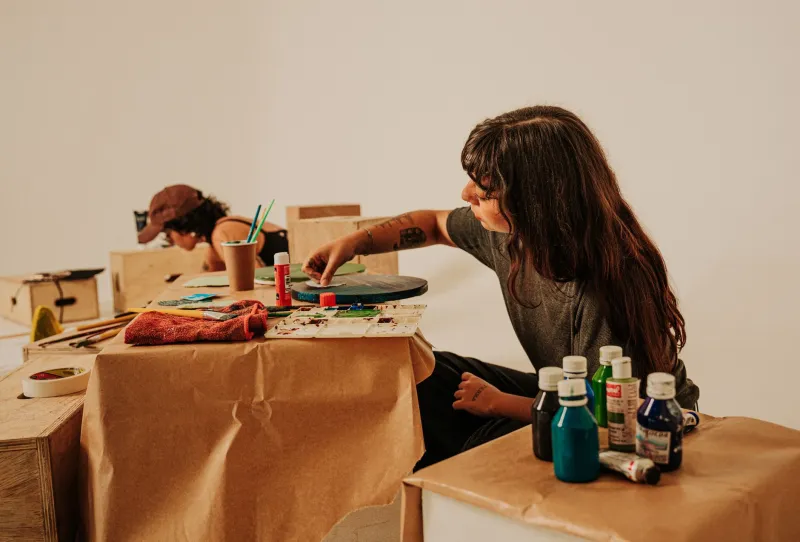
There's a romantic image of the lone artist — holed up in a studio, pouring everything into a singular vision. And look, that story still matters. But if you zoom out and look at which artists are actually paying their bills, growing their audiences, and building something that lasts? A lot of them aren't working alone.
Collaboration has always existed in the arts. What's changed is how deliberate it's become. Today's working creatives aren't just jamming with friends or splitting a studio space out of necessity. They're forming strategic partnerships — across disciplines, across industries, sometimes across the country — with real business logic behind every handshake.
More Than a Side Project
When Brooklyn-based muralist and illustrator Deja Fontaine started collaborating with independent electronic musician Marcus Trell, neither of them expected it to become a core part of their income. Fontaine would create visual artwork inspired by Trell's albums; Trell would score ambient pieces for Fontaine's gallery openings and pop-up events. What started as a creative experiment turned into a packaged offering they pitch together to venues, brands, and festivals.
"We started getting booked as a unit," Fontaine explains. "Venues loved that they could get an immersive experience — sound and visuals — from one conversation. It simplified things for them and doubled our opportunities."
This kind of cross-disciplinary pairing is becoming increasingly common. Dancers are teaming up with UX designers to create interactive performance installations. Photographers are partnering with copywriters to offer full creative campaigns to small businesses. Ceramicists are co-producing content with food stylists to reach culinary audiences neither could access alone.
The through-line? Each partnership expands what either artist could offer solo — and opens doors to revenue streams that wouldn't exist otherwise.
The Business Case for Collaboration
Let's be honest: the arts economy in the US is tough. Grants are competitive, gallery commissions are steep, and building an audience from scratch takes years. Collaboration doesn't solve all of that, but it does something powerful — it multiplies resources without multiplying costs at the same rate.
Shared marketing reach is one of the most immediate benefits. When two artists with different but adjacent audiences team up, both sides gain exposure to people who might never have found them otherwise. It's organic cross-promotion, but with actual creative output behind it — not just a shoutout.
There's also the shared overhead angle. Studio rentals, equipment, production costs, even legal fees — these are all more manageable when split between collaborators. For emerging artists especially, pooling resources can be the difference between making a project happen and shelving it indefinitely.
And then there's credibility. Being associated with another respected artist — especially someone from a different field — signals range and professionalism. It tells clients, curators, and booking agents that you can operate in multiple contexts.
What Makes These Partnerships Actually Work
Not every collaboration is a success story, and it's worth being real about that. Creative partnerships fail for the same reasons any business partnership does: unclear expectations, misaligned goals, and no plan for when things get complicated.
The artists who make it work tend to follow a few consistent practices.
Start with a conversation about money. It sounds obvious, but a surprising number of creative collabs fall apart over revenue splits that were never clearly defined upfront. Before any project goes public, both parties should agree in writing on how income, credit, and expenses are divided.
Define what each person brings — and what they don't. The best partnerships leverage genuine complementary strengths. A visual artist who's great at pitching but struggles with production timelines pairs well with a performer who's disciplined about deadlines but hates sales conversations. Know your roles.
Treat it like a real business relationship. That means contracts, even between friends. It means regular check-ins. It means being honest when something isn't working. The artists who thrive long-term in collaborative models are the ones who bring the same professionalism to their partnerships that they'd expect from any other business arrangement.
Give it room to evolve. Some of the most successful creative partnerships started as one-off projects before growing into ongoing ventures. Don't over-structure things at the beginning. Let the collaboration find its shape before you try to formalize everything.
New Revenue, New Reach
One of the most exciting outcomes of strategic collaboration is access to entirely new revenue categories. A solo illustrator might sell prints and take commissions. That same illustrator, partnered with a motion designer, can now pitch animated brand content — a much higher-ticket offering.
This kind of revenue stacking is becoming a real career strategy. Chicago-based choreographer Nia Voss partnered with a local tech startup to develop a movement-based wellness app. Neither party could have built it alone — Voss brought the creative and performance expertise, the startup brought the development resources and distribution network. The app launched last year and now generates royalty income for Voss on top of her performance bookings.
"I never thought of myself as someone who'd have a tech product," she says. "But that's what collaboration does — it puts you in rooms and categories you'd never get into on your own."
Finding the Right Partners
So where do you actually find collaborators worth building with? The answer, for most working artists, is closer than they think.
Industry events, open studio nights, and arts residencies are all fertile ground. Online communities — whether that's Discord servers for illustrators, Facebook groups for independent musicians, or LinkedIn for more commercially-minded creatives — have become surprisingly effective matchmaking spaces. And don't overlook local arts organizations and co-working spaces, which often facilitate connections between artists in complementary fields.
The key is being intentional. Don't just look for someone you get along with — look for someone whose skills, audience, and goals align with where you want to go. The best partnerships feel natural creatively and make strategic sense professionally.
The Bigger Picture
The collaboration economy isn't a trend. It's a response to the reality of what it takes to build a sustainable creative career in 2024 and beyond. Solo work will always have its place — there's real value in an uncompromised individual vision. But the artists who are thriving right now, the ones building real financial stability and lasting careers, are increasingly the ones who've figured out that partnership isn't a compromise. It's a strategy.
Two creative visions, pointed in the same direction, can go a lot further than one.