Pack Your Bags, Bring Your Work: Why a Creative Residency Might Be the Best Career Move You Haven't Made Yet
There's a version of the artist residency that lives in people's imaginations: a sun-drenched cabin, a painter in a linen shirt, wine at dusk. Lovely, sure. But that postcard fantasy is also the reason a lot of working artists scroll past residency applications without a second thought. Sounds nice, they think. Not really for me.
Here's what that assumption is costing them.
Residencies—whether it's a legacy program like MacDowell in New Hampshire, the storied Yaddo in Saratoga Springs, or one of the hundreds of smaller, emerging retreats scattered across the country—are increasingly being recognized for what they actually are: structured career accelerators wrapped in a quieter setting. And artists who treat them that way are coming home with more than just a cleared head.
More Than a Vacation From Your Life
Let's get one thing straight. A residency is not a vacation. Ask anyone who's come back from one. The days are long, the creative pressure is real, and the work output can be genuinely intense. What a residency removes isn't effort—it's friction.
For most working artists, the biggest enemy of creative progress isn't lack of talent or even lack of time. It's the constant interruption of regular life. The day job. The emails. The gig economy hustle. The social media maintenance. The grocery run. A residency strips all of that away and replaces it with one job: make work.
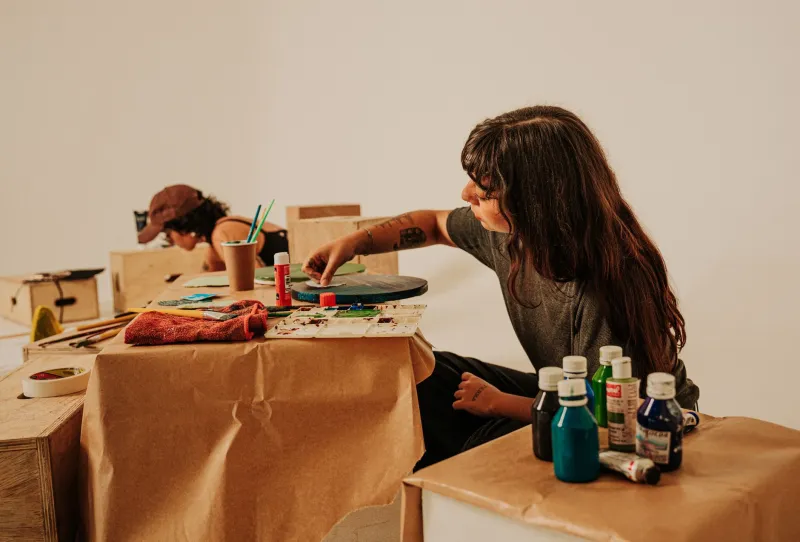
For visual artists especially, that kind of unbroken time can be transformative. Painters, sculptors, and mixed-media artists often describe finally being able to chase an idea to its logical conclusion—something that's nearly impossible when you're working in two-hour windows between other obligations. The work that comes out of these stretches frequently becomes the centerpiece of future exhibitions or portfolio submissions.
Performing artists—choreographers, composers, theater makers—often point to something slightly different: the ability to experiment without consequence. When you're not paying by the hour for a rehearsal space or under pressure to produce something stageable, you can afford to fail. And that's where the interesting stuff usually lives.
The Community Factor Nobody Talks About Enough
Here's the part that surprises most first-time residents: the other people.
Residency cohorts are almost always deliberately cross-disciplinary. You might be a ceramicist sitting at dinner next to a novelist, a sound designer, and a choreographer from Portland. That mix isn't accidental—it's the whole point. And the creative cross-pollination that happens in those casual, low-stakes conversations can be genuinely career-altering.
Collaborations that started at residency dinners have turned into gallery shows, touring performances, and co-authored grants. Introductions made over shared studio space have led to gallery representation. A recommendation from a fellow resident—someone who watched you work, saw your process up close, and respects what you do—carries a different weight than a cold email or a LinkedIn connection.
For emerging artists especially, being in the same room as more established creators in a peer context (not a workshop, not a mentorship program—just coexisting as artists doing their work) can shift something fundamental about how they see themselves professionally.
The Resume Line That Actually Opens Doors
It would be naive to ignore the credentialing angle. Certain residencies carry real weight in the art world, and listing MacDowell, Yaddo, the Headlands Center for the Arts in California, or the Skowhegan School of Painting and Sculpture on your bio signals something specific to curators, grant committees, and presenters: this artist's work has been vetted by people who know what they're looking at.
But even lesser-known programs matter more than artists often assume. Residencies demonstrate initiative, seriousness, and the ability to produce work under dedicated conditions. For artists applying for grants, fellowships, or gallery representation, that track record of seeking out and committing to focused creative development reads as professional maturity.
And the portfolio work itself? That's often the most direct payoff. Many artists time residency applications strategically—applying when they're ready to develop a new body of work, pivot into new territory, or push through a creative plateau. The work produced during those weeks or months frequently becomes the strongest material in their portfolio for years afterward.
Finding the Right Fit (Because Not All Residencies Are the Same)
The residency landscape in the US is genuinely vast and varied. Some programs are fully funded—housing, meals, and a stipend included. Others require a fee that can range from modest to significant. Some are rural and isolated; others are embedded in urban arts communities. Some cater to visual artists almost exclusively; others are built around interdisciplinary exchange.
Finding the right fit matters. An introvert who does their best work in solitude might thrive at a remote writing and visual arts colony in Vermont but feel overwhelmed by a residency built around daily communal critique. A theater maker who needs collaborators might find a solo studio residency isolating in the wrong way.
A few places worth knowing about if you're starting to look:
- MacDowell (Peterborough, NH) — One of the oldest and most respected in the country, open to composers, writers, visual artists, filmmakers, and more.
- Yaddo (Saratoga Springs, NY) — Another historic program with a strong literary and visual arts legacy.
- The Ragdale Foundation (Lake Forest, IL) — A Midwest gem with a beautiful historic setting and a genuinely welcoming culture for mid-career artists.
- MASS MoCA's Assets for Artists (North Adams, MA) — Unique in its focus on connecting artists with practical business support alongside studio time.
- Ucross Foundation (Clearmont, WY) — For artists who want serious solitude and stunning landscape, this Wyoming retreat delivers.
Residency databases like ResArtis and the Alliance of Artists Communities are solid starting points for broader searches, and many state arts councils maintain lists of programs with regional funding opportunities attached.
The Application Is Part of the Work
One more thing worth saying: the application process itself has value. Most residency applications ask artists to articulate what they're working on, why now, and what they hope to accomplish. That kind of intentional self-reflection—putting your creative goals into words, naming the work you want to do and why it matters—is something a lot of artists skip in the daily rush of just keeping things moving.
Even if you don't get in the first time (or the second), the act of applying forces a clarity about where you are and where you're trying to go. That's not nothing.
The artists who treat residencies as a strategic tool rather than a luxury reward tend to approach the whole thing differently—from how they choose which programs to apply to, to how they prepare before they arrive, to how they leverage the work and connections afterward. They come home with new pieces, new peers, and sometimes a genuinely new sense of what their career can look like.
That's not a vacation. That's a career move.