Break It Before You Frame It: How Artists Are Turning Their Studios Into Creative Laboratories
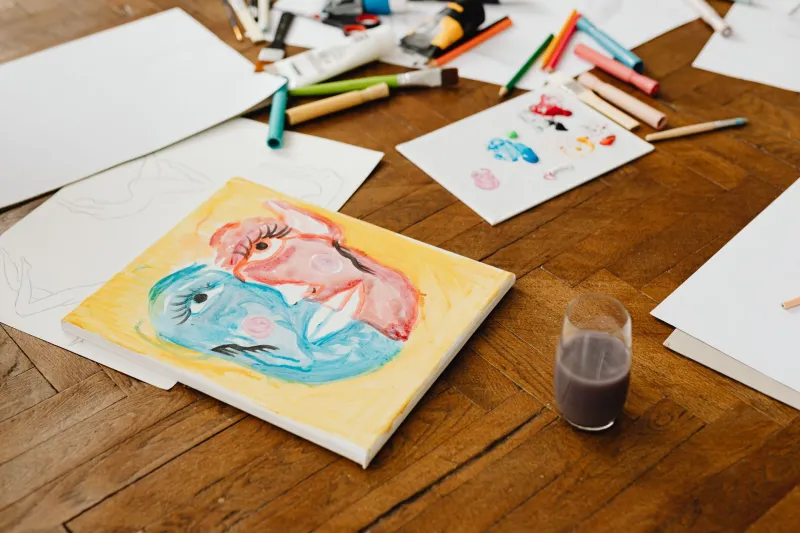
Walk into most working artists' studios and you'll find something unexpected: a lot of stuff that isn't working. Half-finished canvases. Sculptures missing limbs. Notebooks crammed with ideas that went nowhere. And increasingly, that's the whole point.
Across the US, a quiet but significant shift is happening in how creative professionals think about their studio time. Instead of treating every session as a march toward a polished, presentable piece, more artists are borrowing a page from the scientific method — forming hypotheses, running experiments, and logging failures as data rather than defeats. It's a mindset overhaul that's changing not just how art gets made, but how artists feel about making it.
The Problem With Always Playing to the Gallery
For a long time, the studio was treated as a backstage space — somewhere private and functional, existing only to produce the thing that would eventually be seen. The real work happened in public: the exhibition, the performance, the portfolio review. The studio was just the kitchen nobody visited.
That model puts enormous pressure on every creative decision. If every brushstroke is supposed to lead somewhere presentable, you stop taking risks. You stop messing around. You start editing yourself before you've even had a chance to think.
Portland-based mixed media artist Dara Fewell noticed this happening in her own practice a few years back. "I realized I was spending more time in my head judging what I was making than actually making it," she says. "Every piece felt like it needed to justify itself immediately. I was basically holding auditions in my own studio and most of my ideas never made the cut."
So she changed the rules. She gave herself a standing weekly session she calls "lab time" — three hours with no output expectation, no client work, no social media documentation. Just material exploration and deliberate play.
"The first few weeks were genuinely uncomfortable," Fewell admits. "I kept waiting to feel productive. But then something loosened up, and I started discovering things I never would have found if I was trying to make something good."
What the Scientific Method Actually Looks Like in a Studio
Adopting an experimental mindset doesn't mean artists are literally writing up research papers (though some are keeping detailed process journals — more on that in a minute). It means reframing how you relate to uncertainty.
In science, a failed experiment isn't wasted time — it's information. It narrows the field. It tells you something you didn't know before. Artists who've embraced this framing describe a similar shift in how they experience creative dead ends.
New York-based textile artist Marcus Obi keeps what he calls a "failure log" — a physical notebook where he documents every technique that didn't pan out, every color combination that clashed, every structural approach that collapsed. But here's the twist: he revisits the log regularly, looking for patterns.
"Some of my best current work came directly from something I wrote off two years ago," he says. "The context changed, my skill level changed, and suddenly a 'failed' idea was exactly the right solution for a new problem. You can't do that if you just throw the bad stuff away."
This kind of iterative thinking — test, observe, adjust, repeat — mirrors how researchers approach complex problems. And it's producing results that purely output-focused studio practice often can't.
Removing the Audience From the Room
One of the most radical aspects of the lab approach is what it does to the internal audience problem. Most artists, whether they admit it or not, are making work with some imagined viewer in mind. That viewer might be a gallerist, a social media follower, a teacher from art school who said something cutting in 2014. Whatever form they take, that presence shapes creative decisions in ways that aren't always helpful.
Treating the studio as a lab means temporarily evicting that imaginary critic. The work being done isn't for anyone yet. It's research.
Chicago-based performance artist and choreographer Simone Varga describes this shift as "making work that doesn't have to survive contact with the world yet." Her rehearsal process now includes what she calls "throwaway sessions" — movement explorations that are deliberately never recorded or repeated. They exist only to generate information about what her body wants to do.
"It sounds counterintuitive for a performer to make work that no one sees," Varga says. "But those sessions have completely changed what shows up when the camera is on. I'm looser. I'm more willing to commit to something unexpected. I've already been weird in private — I don't have to protect myself from it anymore."
The Permission Structure That Changes Everything
What artists keep coming back to when they talk about the lab mindset is permission — specifically, the act of giving it to themselves.
American creative culture has a complicated relationship with play. We tend to frame it as something you earn after the real work is done, or something reserved for children and hobbyists. For professional artists especially, time in the studio carries the weight of livelihood, reputation, and identity. Every hour feels like it should count.
But the artists thriving under the experimental model have rewritten that contract. Play isn't the reward for finishing — it's the engine that makes finishing possible.
Fewell puts it simply: "The lab sessions don't feel like wasted time anymore. They feel like the most important thing I do, because everything good I make traces back to something I discovered when I wasn't trying to make anything good."
Obi agrees, and adds that the shift has also changed his relationship with his own career timeline. "I used to feel like I was always behind — like I needed to have a complete, polished body of work right now. The lab approach stretched my sense of time. I'm building something, not just producing things."
Starting Your Own Studio Experiment
You don't need a residency or a major schedule overhaul to start thinking this way. A few practical entry points:
Block protected time with no output goal. Even 90 minutes a week designated purely for material exploration — with no expectation of a finished piece — can shift how you approach the rest of your practice.
Document everything, including the misfires. Keep a process journal or failure log. Date your entries. Note what you were trying to do, what happened instead, and what questions it raised. Revisit it every few months.
Separate your lab work from your portfolio work. Not every session needs to produce something shareable. Creating a clear mental distinction between exploration mode and production mode helps protect both.
Invite the weird stuff in. The experimental mindset only works if you're actually willing to follow the threads that seem unproductive or strange. That's where the discoveries live.
The Bigger Picture
What's happening in studios across the country right now is more than a productivity hack. It's a philosophical recalibration — a push back against the idea that artistic value is measured by output volume and public reception.
When you treat your creative practice like a lab, you stop waiting for permission to be in process. You stop treating uncertainty like a problem to be solved and start treating it like the terrain where interesting things happen.
The gallery still matters. The performance still matters. But the work that feeds all of it? That happens in the messy, unglamorous, experimental hours when no one's watching and nothing has to be finished yet.
And honestly? That might be where the best creative work in America is being made right now.