The Piece You Almost Deleted: How Your Creative Misfires Are Winning You Lifelong Fans
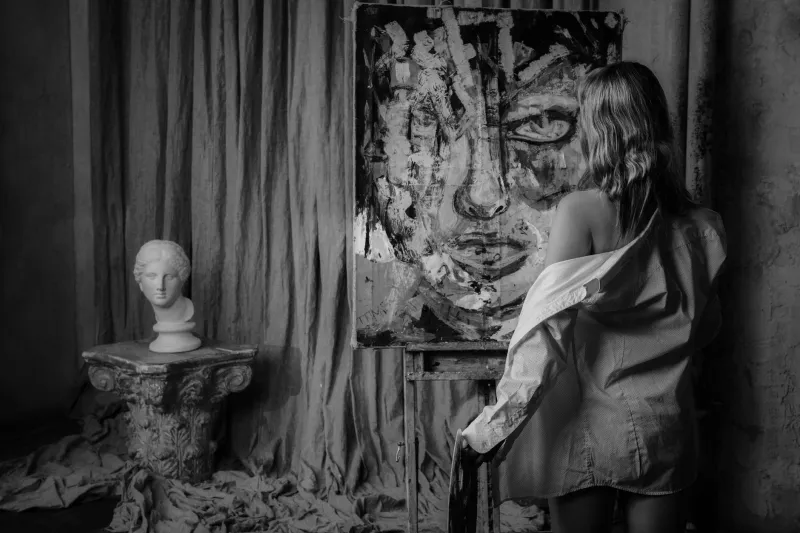
Ask any working artist about their most popular piece and watch what happens to their face. Nine times out of ten, there's a pause. Maybe a small laugh. Then comes the confession: that one? The sketch I did in twenty minutes? The song I recorded on my phone at 2 a.m.? The painting I almost painted over?
Yep. That one.
It's one of the weirder paradoxes of creative life — the work you agonized over least often lands hardest with the people who find it. And understanding why that happens might genuinely change how you think about your entire body of work.
The Myth of the Curated Masterpiece
Most artists operate under a pretty logical assumption: polish equals connection. Put in the hours, refine the edges, present only your best, most intentional work. The logic tracks on paper. In practice, audiences are doing something entirely different with what you make.
Tamara Reyes, a mixed-media visual artist based in Austin, Texas, tells a story that'll sound familiar to a lot of creatives. She spent four months on a large-scale installation piece — intricate, layered, the kind of work that demands sustained attention to fully appreciate. She also, almost as an afterthought, posted a photo of a small watercolor she'd done during a particularly rough week. No caption beyond a single period. Minimal technique. Emotional and a little wobbly.
"The installation got polite compliments," she says. "The watercolor got two hundred DMs in three days. People were sharing things with me I don't think they'd told anyone. It was overwhelming."
What Tamara made in that quiet, unguarded moment wasn't strategic. It wasn't optimized. It was just honest. And that honesty cut through in a way that four months of careful construction couldn't quite replicate.
Why Imperfection Hits Different
There's actual psychology behind this. When audiences encounter work that feels overly polished, there's an invisible wall that goes up — a subtle awareness that they're looking at a performance of competence. The artist is in control. Everything is exactly where it should be. Which is impressive, but not always intimate.
Unfinished work, experimental work, work made under pressure or in grief or on a random Tuesday afternoon — that stuff carries a different frequency. The seams show. The human is visible inside the art. And for a lot of people, that's the moment they feel like they've actually met the artist.
Marcos Delgado, a Chicago-based spoken word performer, experienced this firsthand when a shaky phone video of a poem he performed at an open mic — one he considered "not ready" — got shared across several poetry communities online without his knowledge. "I hadn't even written it down properly yet. I was still working it out in my head. And people were quoting lines back to me that I'd already changed in my head by the time they found the video."
The roughness wasn't a bug. It was the whole point. Audiences weren't just watching a finished poem. They were watching someone figure something out in real time. That's compelling in a way a polished studio recording sometimes isn't.
The Algorithm Doesn't Care What You Think Is Good
There's also a less romantic but equally real force at work here: the algorithm. Platforms like Instagram, TikTok, and even YouTube are not curating your portfolio the way you would. They're responding to engagement signals — comments, saves, shares, watch time — that often spike hardest on content that feels raw or surprising.
A perfectly composed studio shot of a finished painting might look beautiful in a grid. A time-lapse of a painting that went sideways, or a candid moment of an artist staring at a canvas in obvious frustration, will frequently outperform it because it triggers something emotional and immediate. People comment. People tag friends. People send it to their group chats.
This isn't a reason to manufacture messiness — audiences can smell performed authenticity from a mile away. But it is a reason to stop treating your experimental work, your process shots, and your creative dead-ends like they don't deserve to see daylight.
What This Means for Your Body of Work
If your "failures" are quietly building your most devoted audience, that changes the calculus on what you share and when.
For starters, it's worth reconsidering the habit of gatekeeping your own process. A lot of artists keep their sketchbooks, their rough cuts, their early drafts completely private — which makes sense as a protective instinct, but might also be hiding the work that would resonate most.
Jasmine Okafor, a Brooklyn-based illustrator who works primarily in editorial and book publishing, started sharing her "ugly drafts" on a whim during a slow week. She expected crickets. "I thought maybe a few people would feel sorry for me," she laughs. Instead, she built an entirely separate following of people who were specifically interested in her process, not just her finished pieces. Some of those followers became clients. Several became friends.
"The drafts showed people how I think," she says. "Not just what I can do."
That distinction — how I think versus what I can do — is where a lot of the magic lives. Finished work shows capability. Unfinished or imperfect work shows interiority. And interiority is what builds the kind of fan who sticks around long after the algorithm has moved on.
Letting Go of the Hierarchy
None of this means you should stop caring about craft. Deliberate, ambitious, fully realized work matters enormously — both for your own growth and for the kind of career that sustains itself over decades. The point isn't to abandon standards.
The point is to stop sorting your work into a rigid hierarchy of worthy and unworthy before anyone else has had a chance to meet it.
That piece you made when you were upset, when you were experimenting, when you had no idea what you were doing — it might be the exact thing someone out there needed to find. The one that makes them feel less alone, more seen, more willing to try something themselves. The one they'll talk about when someone asks them which artist changed how they think about art.
You might not even remember making it. They'll never forget finding it.
So before you hit delete — or before you decide something isn't ready enough to share — maybe sit with it a minute longer. Your most devoted fans might already be waiting for exactly that piece. They just don't know it yet, and neither do you.